086.001
Al-Hilali and Khan: By the heaven, and At-Tariq (the night-comer, i.e. the bright star);
YUSUFALI: By the Sky and the Night-Visitant (therein);-
PICKTHAL: By the heaven and the Morning Star
SHAKIR: I swear by the heaven and the comer by night;
086.002
Al-Hilali and Khan: And what will make you to know what At-Tariq (night-comer) is?
YUSUFALI: And what will explain to thee what the Night-Visitant is?-
PICKTHAL: - Ah, what will tell thee what the Morning Star is!
SHAKIR: And what will make you know what the comer by night is?
More description about At-Tariq was given in the third verse, describing it as a piercing star
086.003
Al-Hilali and Khan: (It is) the star of piercing brightness;
YUSUFALI: (It is) the Star of piercing brightness;-
PICKTHAL: - The piercing Star!
SHAKIR: The star of piercing brightness;
So from these translations we find that At-Tariq is a piercing star that has a knocking sound. Of course if you know Arabic you will find this meaning very obvious.
Now let us see what modern science says:
Neutron stars are about 20 km in diameter and have the mass of about 1.4 times that of our Sun. This means that a neutron star is so dense that on Earth, one teaspoonful would weigh a billion tons! Because of its small size and high density, a neutron star possesses a surface gravitational field about 2 x 10¹¹ times that of Earth. Neutron stars can also have magnetic fields a million times stronger than the strongest magnetic fields produced on Earth.
Because of its high density, speed, etc., neutron stars can pierce any planet, therefore calling them piercing stars is the briefest and most accurate description could be made and that's what the Quran used.

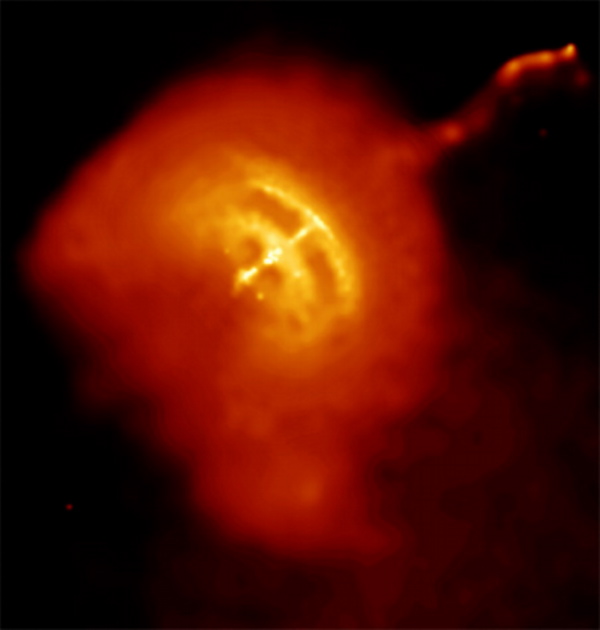
Surprisingly neutron stars were named pulsars because they pulse, i.e. make the sound of knocking which is the literal meaning of At-Tariq:
Click here to listen to At-Tariq (pulsar)
It is worth noting that Pulsars were first discovered in 1967, however their description was given in the Quran 14 centuries ago.